Many distribution and FMCG companies share the same rule: after every sales meeting, the sales rep writes a memo within 24 hours. What was agreed, what the customer wants, what the risks and next steps are. The memo goes to the manager and into the field sales system.
In practice the rule is rarely followed. A sales rep has five meetings a day, drives between them and has to write in the evening. Memos pile up and get written in one go, a week late, from memory. Management learns about agreements and problems too late, and the system stays incomplete.
This is the story of one such project. The client is a large Bulgarian company with an extensive sales network. We work under an NDA, so we don’t name the company, its systems or its internal figures.
Why the rule doesn’t work
It isn’t that people are careless. Writing is the last thing a sales rep wants to do after a full day in the field. And when the memo arrives a week later, it is too late to react to a problem or act on an opportunity.
Here AI doesn’t need to do anything especially clever. It needs to remove the writing.
How the solution works
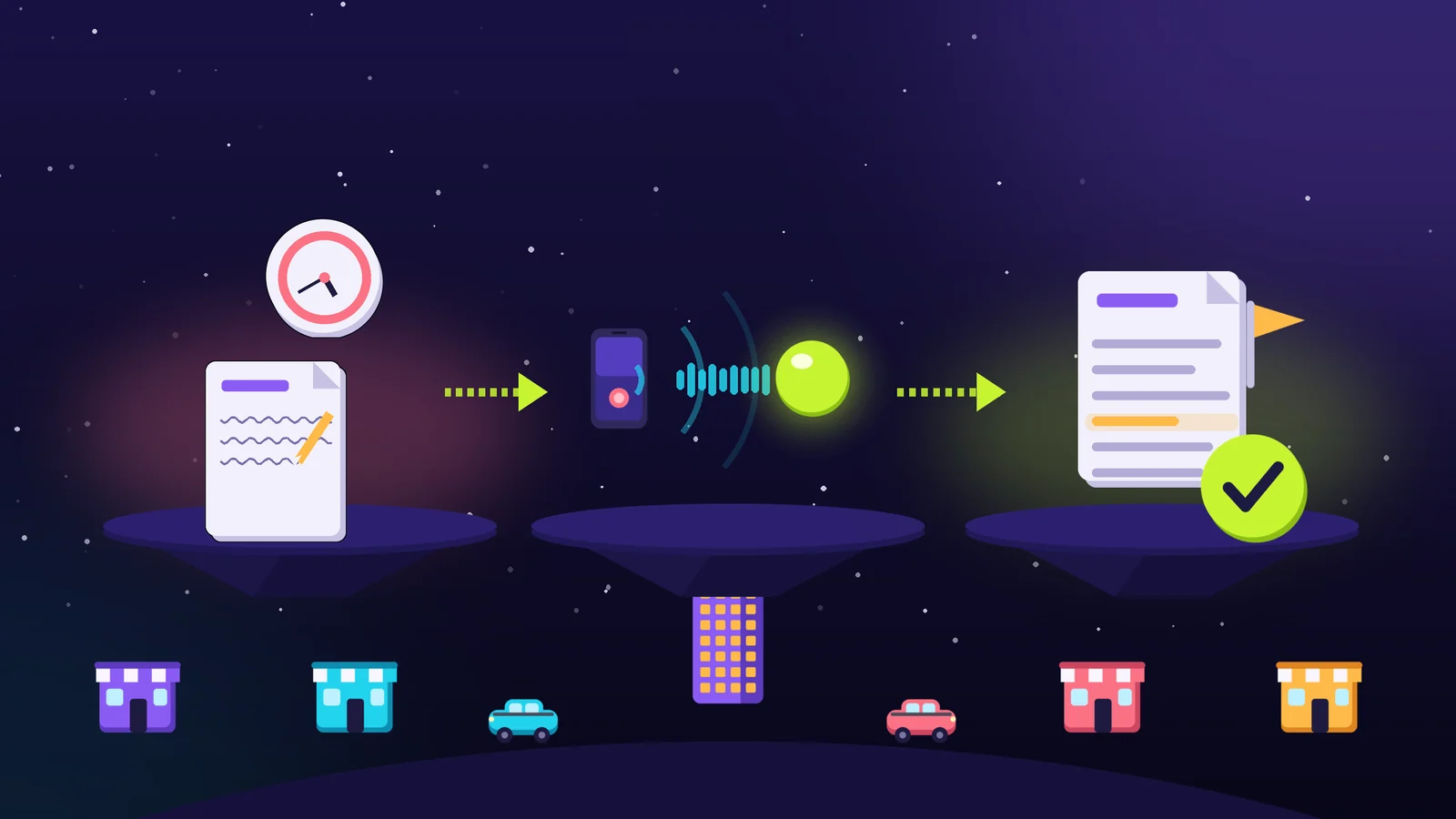
The flow is simple and has five steps:
- Record. The sales rep records the meeting (with the customer’s permission) in a web or mobile app.
- Transcribe. Speech is turned into text automatically, locally, on a dedicated server.
- Memo. AI arranges the content in the company’s memo template.
- For review. Anything unclear is not guessed but flagged with a quote from the recording, so a person sees it.
- Approve and upload. The sales rep reviews, corrects if needed, approves, and the document is uploaded to the company system.
The sales rep doesn’t write. They record and approve.
Why “For review” is the most important part
Management’s biggest fear is that AI “will make up” an agreement that was never made. So the solution is built not to fill in gaps. If the recording doesn’t make clear whether the discount is 3 or 5 per cent, the memo doesn’t choose. It shows the quote and asks the person.
That makes the document slightly less “polished”, but much more reliable. And it gives the sales rep a reason to read the memo before approving it.
How we protect the data
- EU hosting.
- The demo uses synthetic data only: realistic but made-up meetings.
- AI has no direct access to the company’s core systems; it receives the recording and returns a document.
- A person approves every document.
What we measured
These numbers are our own measurements on synthetic data, not results from real use at the client:
- about 2 minutes from a 2-minute recording to a finished document in the template;
- the solution also handles recordings of an hour or more;
- about 20 iterations based on feedback;
- AI running costs are cents per document, with a monthly cap.
What we don’t know yet
To be honest: the project is at the working demo / MVP stage. The solution has been delivered to the client, and a pilot with real sales reps is next. We don’t yet have a measured business impact from real use.
In the pilot we will measure three things: what share of memos go out within 24 hours, how much time the sales rep saves and how many corrections they make before approving. We will publish these numbers when we have them, including if they are more modest than expected.
The principles behind it
- The template belongs to the company. The memo follows the company template, not a format we invented.
- Anything unclear is visible. Flagging “For review” matters more for trust than any explanation.
- The writing disappears completely. If the sales rep has to add things by hand, the solution loses its point.
- IT sees the architecture early. Questions about hosting and access are settled during the analysis, not just before the pilot.
In short
The sales meeting memo is a narrow but painful task. Tasks like this make a good first process for AI in a large company: clear, frequent and measurable. If memos and reports in your sales network arrive late, book a demo of the same flow on synthetic data or read the full case study.